 01
 03
 04
 05
What is a climate tech pitch deck?
A climate tech pitch deck is a decision document that makes an investment or partnership decision easier to understand, evaluate and carry forward. Brighter Future develops investor narratives, pitch decks, partnership decks and high-stakes presentations for climate tech and science-led companies.
In climate, the pitch often has to connect science, economics, deployment risk, regulation, customer demand and a large capital requirement. The deck should assemble that logic for the audience.
Why do investors pass on a climate tech company?
Investors pass on a climate tech company when the story is unclear, or when its mandate, stage, economics, evidence, ownership or timing do not fit theirs. A clear deck brief goes straight to the work. When a raise has stalled and the cause is unclear, start with The Belief Diagnosis.
Where belief breaks
- Evidence
The proposition is supported well enough.
- Clarity
The investor understands the company and the claim.
- Conviction
They believe it matters and can become valuable.
- Commitment
They can justify the investment inside mandate and risk.
When the break sits in the product, customer evidence, economics or investor fit, the deck should expose it early so the team can work on the real problem. We show only supported numbers and the business model as it stands. The raise still depends on the company.
The case has to work after you leave the room
The person who likes your company may have to explain it to a partnership or investment committee. The deck has to close every gap on its own. What the company is, why the market has to change, what evidence exists, what risk remains and what the round makes possible all have to be easy to repeat.
What should a climate tech pitch deck include?
Serious climate investment cases usually answer these questions in a coherent sequence, whatever the slide count.
- DefinitionWhat is the company?
- ProblemWhat market or system constraint matters now?
- MechanismWhat is the new approach?
- EvidenceWhat has been proven?
- CustomerWho buys, adopts or enables it?
- EconomicsHow does value get created and captured?
- MarketHow large can the opportunity become?
- CompetitionWhy this approach and this company?
- ScaleWhat has to happen between today and the larger business?
- TeamWhy is this group credible for that path?
- RoundWhat capital is required, and what will it retire or make possible?
First-of-a-kind companies carry linked risks
A first commercial plant, a new material or an emerging biological platform faces risks that depend on each other. Customers may want supply before signing. Capital may want offtake before financing. The infrastructure may still need building.
The deck should show that dependency and make the real sequence investable on its own terms. Our guide to presenting the complete industrial project shows how to register those dependencies and put each organisation's dates on one timeline.
What is the difference between a teaser, a deck and a data room?
A teaser earns the next conversation, a meeting deck carries the investment narrative and a data room narrative guides an investor through diligence. The deck is one piece of that sequence. Each piece carries the same company definition, figures and evidence status at a different depth, and we build any of them alone or together.
- Teaser
A short document that earns the next conversation. It leaves the full diligence case for later.
- Meeting deck
The coherent investment narrative for serious meetings and follow-up. It carries enough evidence to support the argument and stays easy to navigate.
- Diligence answers
Written answers to the questions that follow the meeting, with every figure matching the deck.
- Data room narrative
A guide through the data room, so each document retells the same case at the status each claim holds.
- The champion's one-page case
A concise, forwardable case for the person carrying the opportunity inside the fund or corporation. It reads more like a one-page memo than a deck.
- Investor updates
Reports between rounds against the milestones named in the raise. They become the evidence base for the next one.
How should a pitch deck separate results from forecasts?
A pitch deck should separate achieved results, current validation, forecasts and targets. Sophisticated investors can then see where each claim ends, and the story is stronger for it.
What we work on
- Investor positioning and a one-sentence company definition.
- Full narrative architecture.
- Slide-by-slide wording and evidence hierarchy.
- Data visualisation and diagrams.
- Teasers and forwardable one-pagers.
- Partnership and corporate pitch variants.
- Founder delivery and rehearsal for high-stakes meetings.
- Follow-up materials and the bridge into diligence.
How does a deck project run?
A Brighter Future deck project takes about four weeks on average. A focused rebuild takes two to four weeks, and we rebuilt Kanop's deck in two. We set the timing at scoping. It depends on the state of the evidence, the number of audiences and how fast approvals come back. A single deck can be the first engagement, and the rest of the sequence can follow in the order you set.
You supply your current materials and the evidence behind your claims. We also need two or three working sessions with your leadership team, one person who signs off and a technical lead who checks claims.
Each stage has two rounds of review. Your technical lead signs off every claim, and we keep the evidence register. We do not build financial models or run ad campaigns. Your finance team owns the figures.
At handover you receive print-ready and digital PDFs. The studio keeps the source and production files. Fees are agreed per project and fixed before work starts.
How do you test a deck before the meeting?
Test a pitch deck before the meeting by giving it to someone sharp who is new to the founder’s pitch. After ten minutes, ask them to explain the company back to you. If their version differs materially from yours, find where the logic broke. That gap shows you where to work next.
Relevant work
- FronterraA rebuilt seed deck and investor narrative for a forest carbon and biodiversity operator in Peru, with the track record moved into the investment case.Case study

- EedenPitch strategy and storytelling for a partnership pitch to a major fashion brand, which Eeden says directly contributed to securing a Letter of Intent.Case study

- KanopInvestor storytelling and presentation design explaining its forest intelligence technology and investment case.Case study
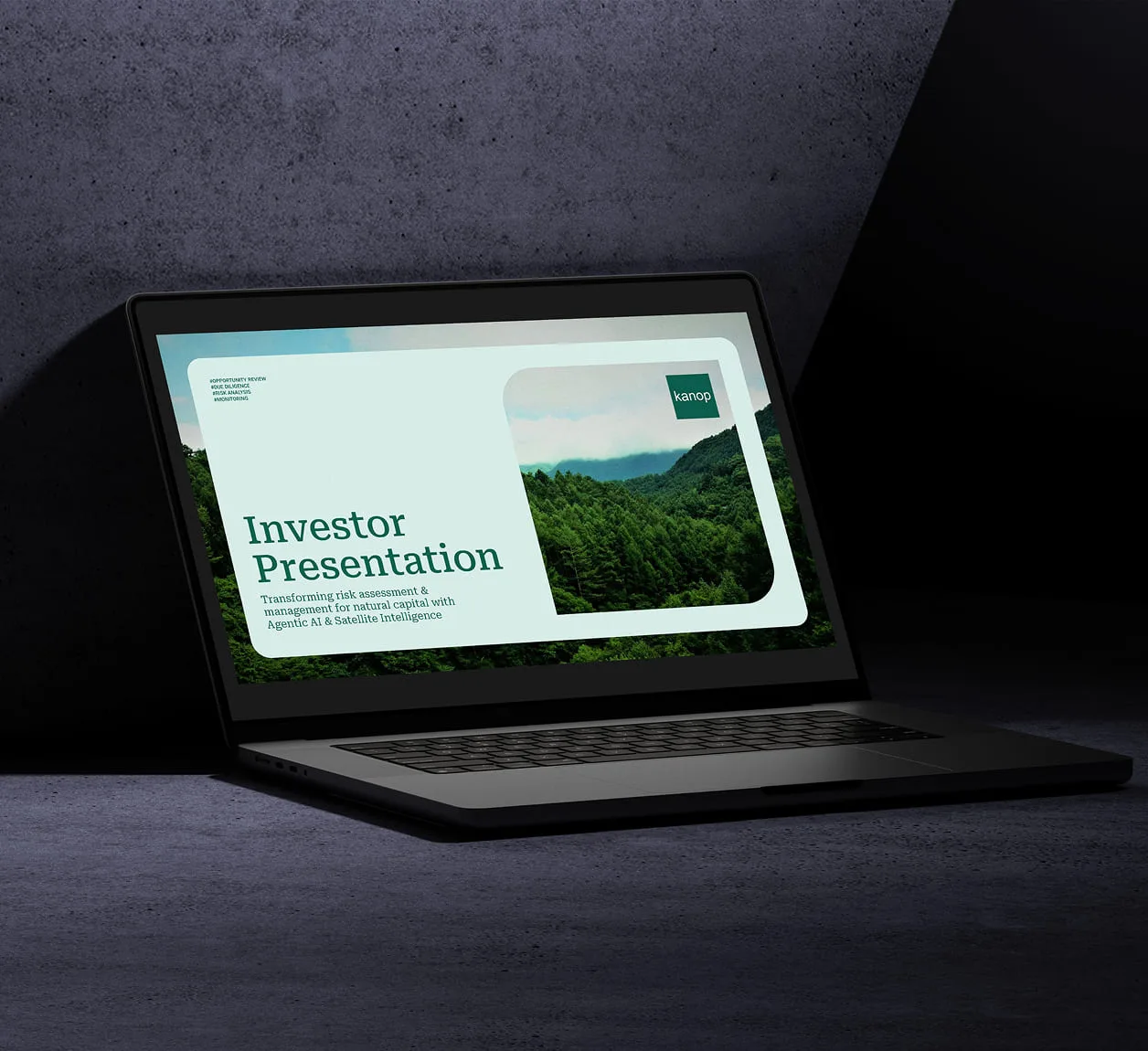
- KoraloWhen the opportunity moved, the investor story moved with it, from story architecture to the teaser and deck.Case study

Frequently asked questions
Do you design decks as well as write them?
Yes. We develop the narrative, wording, evidence hierarchy and visual design together.
Can you work from an existing deck?
Yes. Sometimes the right job is a focused rebuild. Sometimes the current material reveals a deeper positioning problem to solve first.
Do you work on partnership and corporate decks?
Yes. The decision logic differs from venture fundraising. We still start with the stakeholder, the case they need to carry and the commitment you are asking for.