 01
01

 02
02 03
03 04
04Climate tech branding is a decision system
Brighter Future is a senior-led brand and communications studio for companies across climate technology, nature, circular materials, food, biotech and other science-led markets. We build positioning, narrative and identity together, then carry that system into the websites, decks and materials that have to move real decisions.
Teams find us as a climate branding agency, a sustainability branding agency or a climate design studio. We work as a studio so strategy and execution stay close together.
What climate branding has to do differently
A climate company asks several audiences at once to evaluate unfamiliar technology, long time horizons, technical evidence and sometimes a whole new category. Each of them reads the brand for something different.
Who reads a climate brand
- Investors
The path from proof to scale.
- Corporate buyers
Performance, integration and procurement risk.
- Technical reviewers
Methods and limitations.
- Future employees
Why the company exists.
The brand has to speak to each of them as one company. So we start with the decision environment, and the moodboard comes later.
Signs the brand has fallen behind the company
- The CEO rewrites the company description for every important meeting.
- The website still sounds like the seed-stage business, while the company now sells to institutions or corporates.
- Investors understand the science and struggle to explain the commercial wedge.
- Customers keep putting the company in the wrong category.
- Different teams tell incompatible versions of the proposition.
- The visual identity makes a technically serious company look generic, immature or interchangeable.
- Proof sits in scattered PDFs, decks and technical documents, away from the visible story.
What we build
- Positioning and category definitionwhat the company is, where its boundaries sit and the market frame it should own.
- Audience and decision mappingwho has to understand, evaluate, approve, buy or fund the work.
- Story architecturethe origin, purpose, vision, customer, product and impact stories, each built as a separate strategic asset.
- Messaging and verbal identitycompany definition, proposition, proof language, hierarchy and tone.
- Visual identityidentity, typography, imagery, diagrams and a design system built around the content the company publishes.
- Decision materialsinvestor decks, partnership proposals, sales materials and internal champion documents.
- Websiteinformation architecture, copy, evidence layer, responsive design and launch assets.
- Handovertemplates, governance and rules the team can run on its own, including which claims can be made, which need evidence and which are still hypotheses.
The Brighter Future method
- Start with the live decision
We name what has stalled, whether a raise, category understanding, an enterprise sale, a partnership, a rebrand, market entry or internal alignment. That keeps brand strategy concrete.
- Find the first break
The Belief Gap asks whether the blockage sits in evidence, clarity, conviction or commitment. If the first problem lies outside branding, we want to find that early.
- Build the stories
We decide which of the six stories each audience needs. The thinking underneath is deep, so the copy can stay short.
- Design an identity that carries evidence
We design the visual system with the words, so technical claims, data, use cases, diagrams and long-form proof are easier to follow. It has to work in a board deck and on a technical page as well as in a launch animation.
- Build the materials that move the decision
We test the system in the website, investor deck, partnership material and templates, well past the logo stage.
When a full rebrand is worth doing
A full rebrand pays off when inconsistency keeps costing you. When the blocker sits elsewhere, a smaller scope may be smarter.
- Every senior conversation starts from scratchFull rebrand
- The market routinely misunderstands the categoryFull rebrand
- Important proof stays hiddenFull rebrand
- The organisation has outgrown its identityFull rebrand
- The product-market question is still unresolvedStart with a smaller scope
- The company has little customer evidenceStart with a smaller scope
- The underlying economics are the real blockerStart with a smaller scope
Our diagnostic guide sets out how to tell these cases apart.
Built from what the company already has
Leaves, gradients, abstract planets and vague “better future” language make very different climate companies look interchangeable, so we leave them alone.
The distinctive material usually sits inside the company already. It is in the mechanism, the data, the market tension, the deployment environment, the physical infrastructure, the founder’s conviction and the proof. The identity should reveal that specificity.
Relevant work
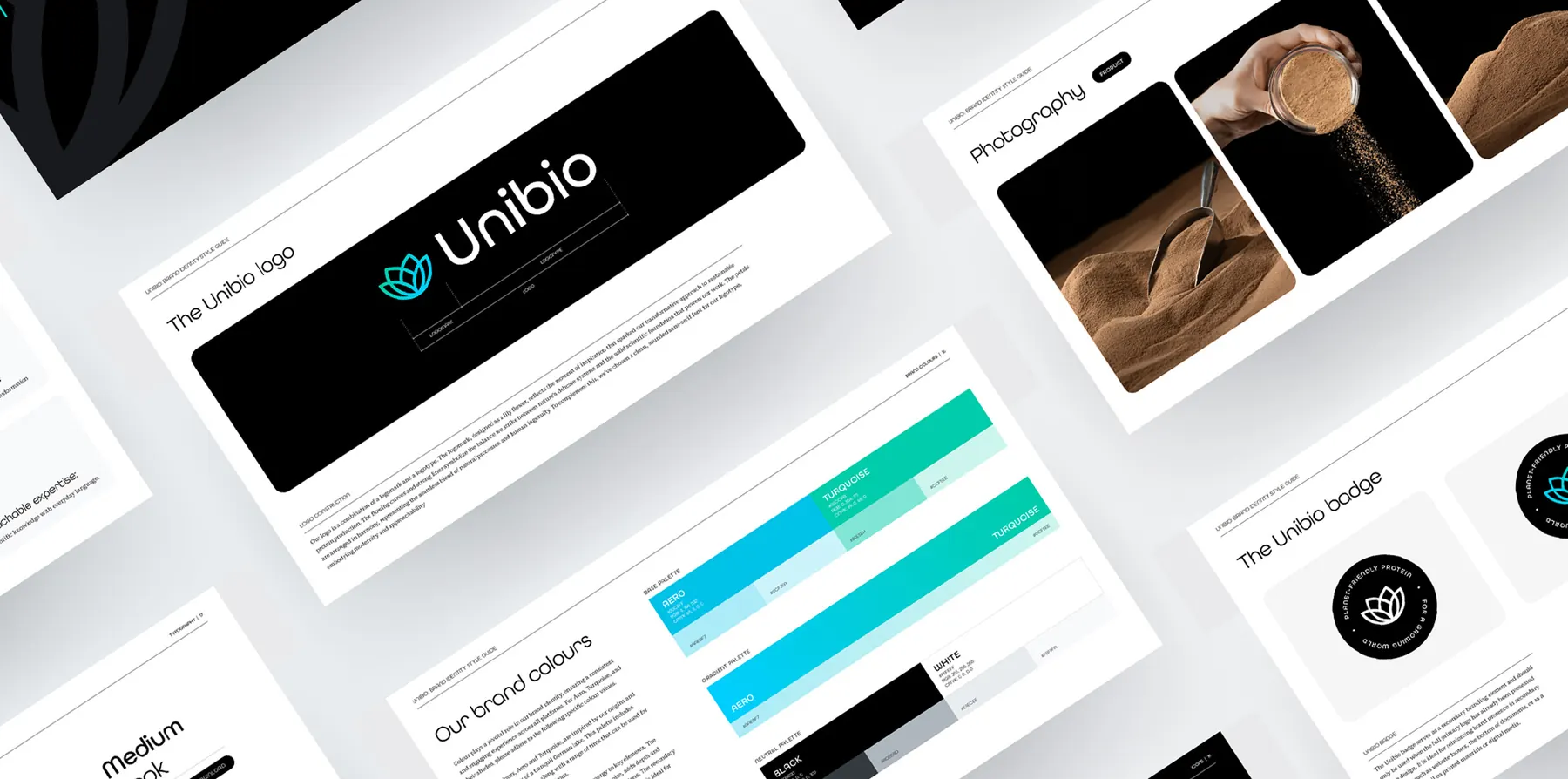
Clients include Unibio, ERS, Fair Carbon, Eeden, DNAir and other climate and science-led teams. The scope varies. The recurring problem is a company whose substance the team sees more clearly than the outside world does.
Frequently asked questions
Do you only work with climate startups?
The work spans climate, nature, circular materials, biotech, food systems and other science-led organisations, at any age, wherever complex substance has to become a clear external case.
Can you work with an existing identity?
Yes. When the first break lies elsewhere, we work on positioning, narrative, decks or a website inside the existing system.
Do you do both strategy and design?
Yes. The same senior people shape the proposition, copy, information hierarchy and visual design as one system.
What should we bring to a first conversation?
Bring the decision that is stuck, the material you use today and the evidence behind the case. That shows us what the communication has to do before anyone asks for a logo or “better messaging”.