 01
01 02
02 03
03 04
04 05
05A free guide · October 2026
The Belief Gap.
Why investors, buyers and boards believe you and still wait. Ten chapters, one worked case, and a method for finding where a sound case stops moving.
Pick one case you expected to have moved by now. The guide gives you a method to find where it stopped, and an hour is enough to reach a first hypothesis you can test.
You already have the guide in this browser.
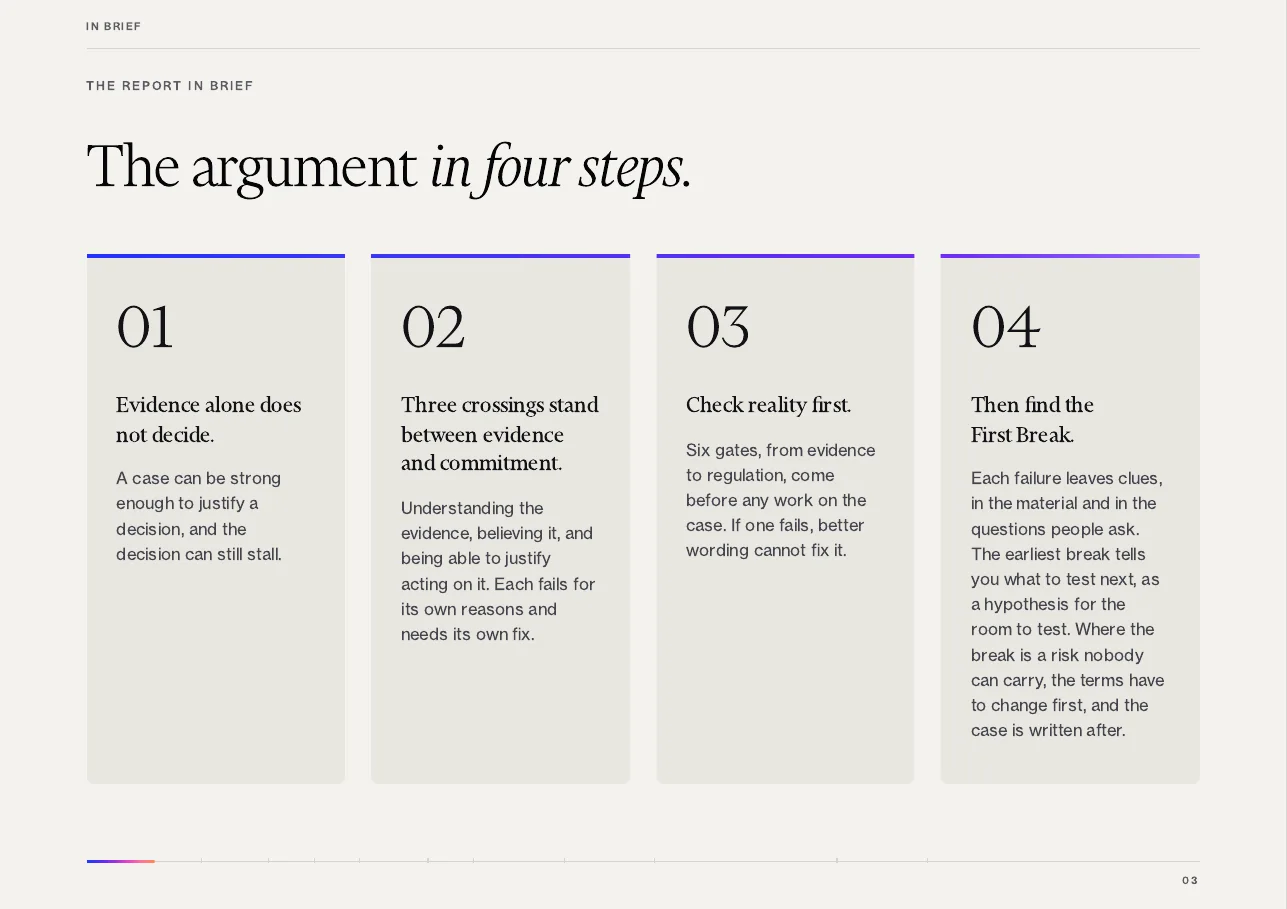
The argument in four steps
A case can be sound, understood and believed, and still wait.
Evidence alone does not decide.
A case can be strong enough to justify a decision, and the decision can still stall.
Three crossings stand between evidence and commitment.
Understanding the evidence, believing it, and being able to justify acting on it. Each fails for its own reasons and needs its own fix.
Check reality first.
Six gates come before any work on the case. Evidence, economics, incentives, authority, capacity and timing, and regulation. If one fails, better wording cannot fix it.
Then find the First Break.
Each failure leaves clues, in the material and in the questions people ask. The earliest break tells you what to test next.
Three clues from the opening chapter
None of these studies tests the model in the guide. Together they suggest it pays to find where a decision stalled before adding more proof.
Contents
Where good cases stop moving.
- Chapter 1More proof, and where it lands
- Chapter 2Three places a decision can stop
- Chapter 3Rule out reality first
- Chapter 4Where understanding and belief fail
- Chapter 5Convinced, and stationary
- Chapter 6When there is no precedent
- Chapter 7Changing the exposure
- Chapter 8Finding the First Break
- Chapter 9The recycler, as far as one case goes
- Chapter 10Bring the case that should be moving and isn’t
- AppendixMethod, related work, evidence, tests, a sample Review, cases, countries
- SourcesEndnotes
What you leave with
- A way to tell whether a stalled decision needs more proof or something else
- Six checks to run before rewriting anything
- A method for finding the First Break in your own case, and a first hypothesis within an hour
- One worked case to test your reading against
For anyone asking investors, buyers, boards or funders to commit to something new.
What it rests on
Published research, cited in the endnotes, and the author's own experience and insights from the cases he has worked on. Chapter 9 sets out those cases and one public case. Where a claim is the author's own reading, the text says so. Every claim is marked as direct evidence, transfer evidence, practice observation or the author's hypothesis. The appendix sets out five tests that would establish the method, and a later version will start them.
“The usual reading of a stall like this is that the case is too weak, and the usual repair is to strengthen it. This report starts by asking where that repair lands.”
From the opening, on a textile recycler whose first customer could discuss the proposition in detail and still would not sign.
The essay series