 01
01 02
02 03
03 04
04 05
05A free course · Beta
Before they believe the work, they believe you.
Leave with the six stories your company runs on, written once in depth and cut for the investor meeting, the website, the sales call and a new employee.
This browser is already in.
- Origin
- Purpose
- Vision
- Customer
- Product
- Impact
- PartsFour, in order
- StoriesSix
- OutputYour Story System
What you will use it for
Four rooms where the stories do the work.
Each story is written once in depth, then cut to the length a room gives you. These are the moments founders use them most.
The investor meeting
Open with the sixty-second Origin and let the Vision carry the ask, so the room meets you before the numbers.
The website rewrite
Choose the hero line from what you sell right now, belief, the promise or proof, and cut the rest of the page from the same source.
The sales call
Lead with the Customer story so the buyer recognises their own situation before you describe the product.
A new employee's first week
Hand over one document that holds all six stories, so new people tell the company the way you do.
The six stories
Every company runs on six stories.
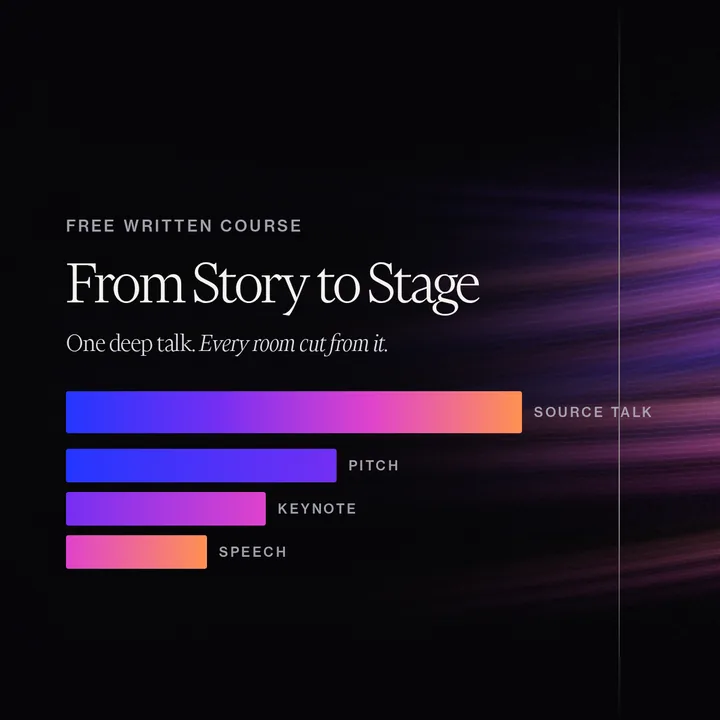
You build six stories, write the private source version behind each one, then cut them into the versions you use in a pitch, on your website, in sales, in hiring, and in the rooms where your company has to be believed.
Origin · Trust
Why you started.
Purpose · Conviction
The fight you are in today.
Vision · Destination
Where it is going.
Customer · Recognition
Their world, from inside.
Product · The promise
What becomes true for them.
Impact · Proof
The promise kept.
A worked example
Same person, same facts. A different story.
The course follows one founder, Clara Voss, through all six stories. Here is her Origin Story as most founders tell it, and the sixty-second telling cut from her private deep version.
The before
Clara Voss is the founder of a nature-based solutions platform working with landowners across Europe to restore degraded farmland through carbon and biodiversity credit markets. With a background in land management consultancy, Clara brings seven years of industry experience to the challenge of large-scale ecological restoration.
Competent. Accurate. Already gone from your memory.
The after · the telling · sixty seconds
Clara grew up on the edge of a working forest in southern Germany. She learned to identify trees by the smell of their bark after rain. She took a job in land management because it felt responsible. For seven years she was good at it.
Then she flew to a site in the Po Valley. The soil was hard under her feet in a way soil should not be. No insects. No sound. A skylark had nested near the northern boundary three years before. There was nothing there now.
She understood, as something she felt in her chest, that she had been on the wrong side of something. She left in the spring, with no business plan and a single conviction.
The first landowner who trusted her sat in his farmhouse kitchen on a Tuesday afternoon. Outside, rain on the windows. Inside, seven years of records that showed his worst fields getting worse every year. She told him what she thought was possible. He did not say anything for a while. Then he said, what would we do first.
Cut from Clara’s deep version, 1,741 words. Nothing in it was written for an audience.
The land can come back, and I am making that simple for the people who own it.
The version above. The length at which this story does its best work.
Cut from the deep version when the room gives you the time.
Private. Every version is cut from it, and none is written separately.
What is inside
One method, in the order it works.
- 01FoundationsNine short lessons on why a story lands and a pitch does not.
- 02BuildThe six stories, one at a time, in order. Each one uses what the one before it established.
- 03SystemThe Master Table, the three lengths, and the six-story pitch.
- 04WorkYour stage, the Context Bridge, and the rooms and channels, from the investor pitch to sales, the website and hiring.
- 05KeepThe quarterly review, the team, the story you tell yourself, and the capstone.
For each story you write a private deep version, 800 to 1,800 words for nobody, then cut it into the versions you use. See every lesson.
How the course works
Read, decide, keep the result.
- 01
Free to use
The course is free. It asks for your email once, before the full lessons open, and the work you write stays in your browser.
- 02
Write as you read
Each lesson asks you to decide or write something. Talk a deep version into a voice note or write it straight down. It all builds into one document.
- 03
Bring us the live case
The course teaches the method we use with clients. When a real decision has stalled, the Belief Gap Diagnosis finds where it stops moving, in two to three weeks.


Who this is from
I built this because I needed it.
Founder of Brighter Future. Co-founder of The Decision Room.
I work on high-stakes communication problems. The pitch, the raise, the decision a room has to make and is not making. I co-founded and run The Decision Room, a closed-door capital convening in Zürich, and I run Brighter Future Studio, the creative studio that built this course.
I made the method public because the ideas should not be the scarce part. The Story System builds what needs to be said. When a decision that matters still is not moving, a raise, a launch, a repositioning, the Belief Gap Diagnosis finds the belief, the evidence or the sequence that is stopping it. That is the studio’s work.
More about AaronQuestions
Before you start.
Is The Story System free, and what happens to my email?
Yes, the whole course is free. One email opens the full course in your browser, and you enter it once. Your address is never shared, there is no automated sales sequence, and you can leave at any time.
How long does the course take?
Seventy-five lessons in four parts. Plan for about four hours of reading and six writing sessions of fifteen minutes each. You can work one story at a time, and the course remembers your place on that device.
Can I see the lessons first, and why does it say beta?
Yes. The public lesson index lists all seventy-five lessons, each with its opening passage, before you enter an email. The course is in beta while its first readers test it, and every course page carries Report a problem.
Where is my writing saved?
In your browser, on your device. Everything you write saves as you type and gathers into one document, Your Story System, which you can print or back up to another device.
What are the six stories, and why that order?
The six are Origin, Purpose, Vision, Customer, Product and Impact, with the jobs of trust, conviction, destination, recognition, promise and proof. Origin comes first because every other story rests on it. Each later story uses what the one before it established, so the order is the method.
What is the deep version, and how is it used?
The deep version is a private draft of each story, 800 to 1,800 words, written for nobody. You cut it into a six-second line, a sixty-second telling and a six-minute long form, and nothing public is written fresh. The telling is one scene and what it means, and the line is one sentence other people repeat without being asked.
How do the stories get used in a pitch, on a website, in sales and in hiring?
Each room takes its own stories in its own order. An investor pitch runs Origin, the Context Bridge, Impact and Vision, and a sales call runs Customer, Product and Impact. A website places four stories at fixed positions, and hiring runs on Vision and Purpose.
What is the Context Bridge?
The Context Bridge answers the question of why now. It is a short, evidence-based argument about one or two things that changed in the world, such as regulation, technology, cost or a new risk. In a pitch it sits right after the Origin.
Can a team use the course?
Each person's writing saves in their own browser. The course shows how to share the deep versions with your team, with the private layer taken out, so colleagues tell the stories in their own voices. A new employee who speaks for the company reads the deep Origin, Purpose and Vision, and salespeople start from Customer and Product.
What do I end with?
You end with Your Story System, one document that holds all six stories, their lines and the rooms they lead in. It opens with the Master Table, the whole system on one page, ready to print or hand to a team. A one-hour quarterly review keeps it true as the company changes.
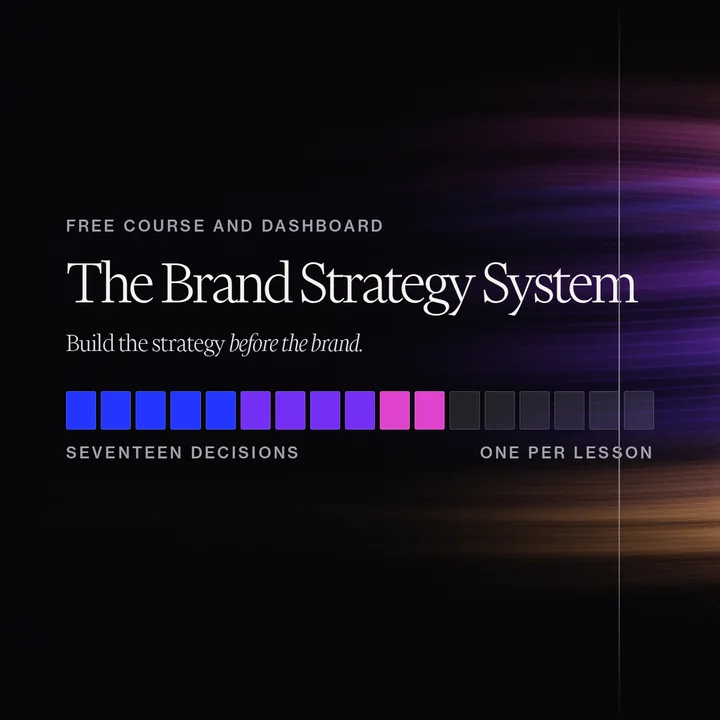
Free · Opens with an email
Start with the story you already have.
Six stories, written once in depth and cut for every room. Your writing stays in your browser.
The Story System is free. It is in beta, and every course page carries Report a problem. Written by Aaron C. Leaman, published by Brighter Future. Your writing stays in your browser.