 01
01 02
02 03
03 04
04
Sections
A pitch deck has a job beyond getting attention. It has to make a consequential decision easier to understand, evaluate and carry forward. That is especially true in climate, biotech, materials and other evidence-heavy companies, where an investor may be evaluating science, economics, deployment risk, regulation, customer demand and a substantial capital requirement at the same time. The deck should reduce the amount of logic the investor has to reconstruct.
Before changing the slides, diagnose the pass
The Belief Gap framework separates four states, which are Evidence, Clarity, Conviction and Commitment. An investor can pass at any one of them. The evidence may be insufficient. The company may be difficult to understand. The investor may understand it and still not believe the opportunity is compelling. They may believe it and still be unable to invest because of mandate, economics, ownership, timing or risk.
This is why the first job is finding the first break, before anyone assumes a prettier deck is the repair.
There is no universal slide order, but there is a decision sequence
A serious investment case usually needs to make a set of questions legible. The investor needs to know what the company is and whether it fits them, what specific problem or market constraint exists, and what the company has built and how it changes the current approach. They need to see what has been demonstrated technically and commercially, and what remains uncertain.
They also need to understand who pays, what market is reachable and how value is captured, and why this team is credible for the next stage. Finally, they need to know what changes when the round has done its job, how much capital is being raised and what exactly they are being asked to decide now.
Those questions need to be answerable, whether or not they become nine slides in that order. The strongest decks feel inevitable because each answer makes the next question easier to ask.
The case has to survive the room you are not in
The person who likes the company may still need to explain it to a partner or investment committee, and the founder is not always there. That makes portability a strategic requirement. A portable case makes it easy to repeat what the company is, why the market has to change, what evidence exists, what risk remains and what the next round unlocks. If the deck depends on the founder verbally repairing every transition, it is not yet doing enough work.
This is true in corporate pitches too. In our work with Eeden, the first audience was not necessarily the final decision-maker. The story had to survive technical, procurement, legal and budget conversations after the initial meeting. The person carrying it internally needed to understand the buyer's problem, the mechanism, the evidence, the uncertainty and the next commitment worth making. That is the internal-champion test.
Use of capital should buy a change in risk
For capital-intensive companies, "we are raising £10m to scale" says very little. The investor needs to understand what the money changes. That starts with whether the round funds a demonstration plant, certification milestone, first commercial deployment, manufacturing line, regulatory submission, project pipeline or customer qualification programme. Then ask what uncertainty is materially reduced when that milestone is reached.
The round is a bridge between today's risk and tomorrow's evidence. That connection matters in investment storytelling because it makes the relationship between capital and value creation easier to evaluate.
Technical proof and commercial proof are different
A lab result can prove mechanism. A paid pilot can prove customer engagement. A contract represents a stronger level of commitment. A pipeline can show opportunity without becoming booked revenue, and a signed LOI can matter without becoming a sale. The deck should label those states accurately. One precise proof point is stronger than five inflated adjectives.
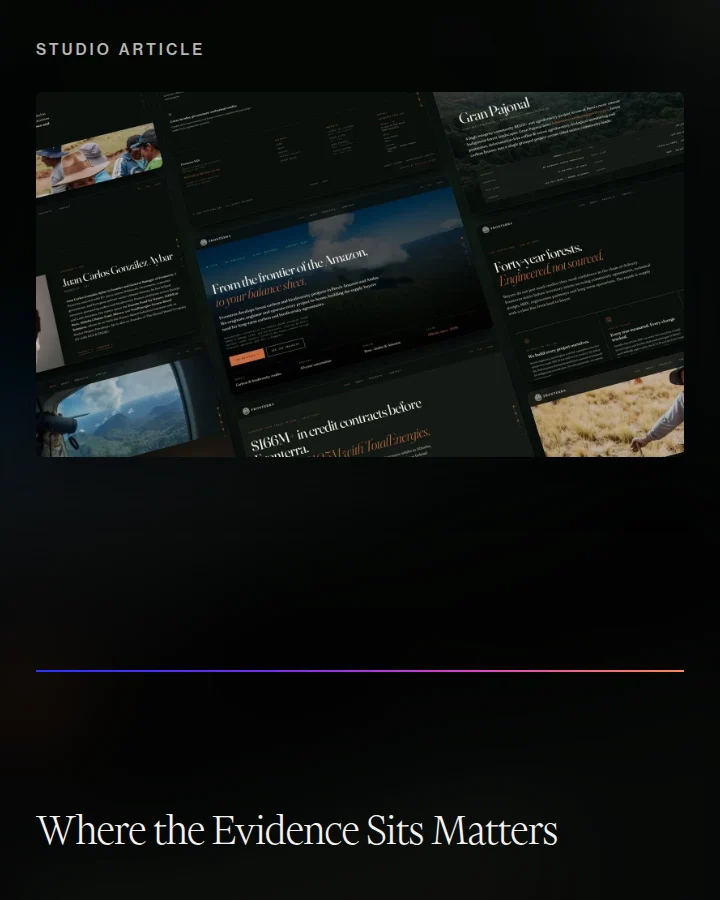
This was important in Fronterra as well. The investor material was rebuilt from the same strategic foundation as the website so the company definition, project facts, track record and operating model stayed consistent as the material became more detailed.
Fronterra's CEO later told us that board members and investors had described the new investor material as some of the strongest pitch material they had seen. That is client-reported feedback. It is useful proof of how the communication landed, and it should stay separate from any claim that the deck caused a later investment outcome.
Story belongs in the deck when it earns belief
Origin and Vision can both matter in an investment case. A founder story can strengthen credibility when the experience genuinely explains why this team saw the problem differently. A Vision Story can help an investor understand the future the company is trying to build and the role it expects to occupy within it.
Neither should replace evidence. Vision becomes dangerous when it is presented as forecast. Origin becomes distracting when it is biography with no bearing on execution. Story should make the investment logic more human and memorable while the gaps stay in view.
Remove the founder and run the two-minute test
A useful final test is to imagine that the founder has left the room. The reader should then be able to explain, in two minutes, what the company is, who buys, what is proven, what remains risky, why this team, how large the opportunity could become, what this round funds and which milestone the capital should unlock. If they cannot, find the missing transition before adding another slide.
An investor deck is a decision document.
Tell us what needs to move.
Bring the brief if it is clear. If it is unclear, tell us where the work is stuck.
Bring us the problem